
1. Why Toddlers Lock Into Rigid Meltdowns
To an adult, a sudden downpour ruining an outdoor picnic is an inconvenience. To a 3-year-old who has built an entire mental picture of sitting on a checkered blanket with their friends, that rain feels like an overwhelming catastrophe.
Why 2 Year Old Tantrums Peak (The Language vs Emotion Lag)
If you are navigating frequent, explosive 2 year old tantrums, you are in the thick of a universal developmental leap. At age two, a child understands hundreds of words and has intense preferences, but their expressive speech and emotional regulation are still catching up. When a 2-year-old cannot make you understand that they wanted to zip their own coat or that their banana broke in half, frustration spikes instantly into a full bodily meltdown.
Understanding that 2 year old tantrums are an involuntary nervous system overload—not defiance—helps parents shift from frustration to gentle, calm co-regulation.
The Concept of Cognitive Flexibility
In child psychology, cognitive flexibility is the ability to switch between thinking about two different concepts or adjust when rules change unexpectedly.
Toddlers are naturally rigid because their world is largely outside their control. When their expectations shatter, their nervous system perceives a loss of safety, triggering the fight-or-flight tantrum cycle.
Trying to talk a child out of a tantrum with adult logic ("It's just rain, stop overreacting!") never works because the rational thinking brain is temporarily offline. Instead, we must first validate the disappointment, and then gently introduce an engaging alternative.
2. The 3-Step "Plan B" Method
In The Picnic That Rained Away, Barnaby the Badger has packed a perfect picnic basket when torrential woodland rain begins. Rather than forcing him to pretend he isn't disappointed, the woodland friends teach him the power of "Plan B".
How to Use the "Plan B" Switch
- The Puddle Phase (Acknowledge & Validate): Give them permission to feel sad for 60 seconds without rushing to fix it. Say: "You were so excited for the park today. It really hurts when Plan A breaks."
- Take the Reset Breath: Practice Ruby Robin's 4-4-4 deep breath (Inhale courage, hold, blow out frustration like a dandelion seed).
- Launch Plan B as an Adventure: Reframe the disappointment not as a loss, but as a secret woodland challenge: "Plan A is washed out! Who wants to build an indoor blanket fort and eat our sandwiches by flashlight?"
3. What Early Years Educators Say
From the Early Years Classroom
"The children especially loved the scavenger hunt checklist at the end... It was a fantastic extension activity that brought the story to life."
— Elizabeth P., Early Years Setting
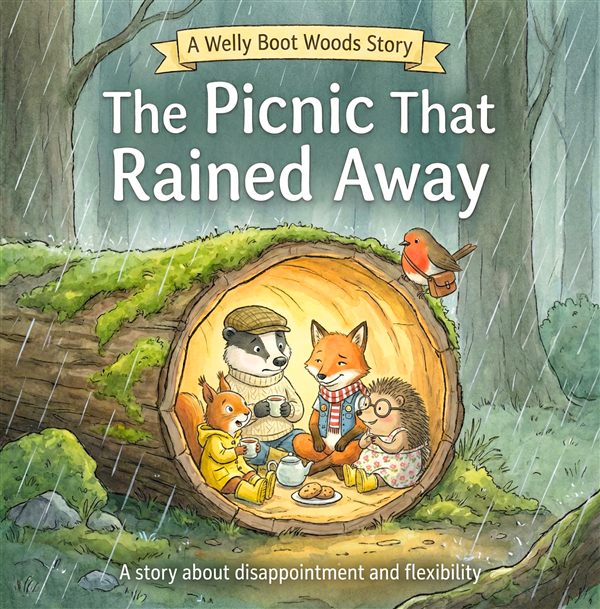
The Picnic that Rained Away
Pip and Barnaby planned the ultimate woodland picnic, but dark clouds gather and down pours the rain! A heartwarming rhyming story that teaches young children how to handle disappointment, adapt with humor, and discover that muddy puddles can be even more fun than sunshine.
5. Frequently Asked Questions
2 year old tantrums peak because a toddler's desire for independence and rapid comprehension outpaces their ability to express complex emotions or self-regulate. Their prefrontal cortex is still developing, meaning big emotions instantly trigger an involuntary nervous system overload. The best approach is not punishment, but calm co-regulation: get down to eye level, acknowledge their disappointment (the "Puddle Phase"), and use simple storybook routines like the "Plan B" switch from The Picnic That Rained Away to guide them out of the spiral.
Remind yourself of this simple mantra: "My child isn't giving me a hard time; they are having a hard time." Take two slow, deep breaths before speaking. Lower your voice rather than raising it—toddlers often drop their volume to match yours.
Children as young as 2.5 can begin grasping the language of 'Plan B' if it is paired with tangible stories and playful routines. Repetitive stories like The Picnic That Rained Away give them a concrete mental reference point.