
Why Toddlers Say "NO!" to Everything (And How to End Daily Power Struggles Gently)
"Shall we put your shoes on?" "NO!"
"Would you like an apple?" "NO!"
"Would you like to go to the playground?" "NO!"
If your two or three-year-old seems to reject every single request before you have even finished your sentence, take comfort: you are not raising an obstinate child, and you have not lost control. You are witnessing one of the most vital, explosive milestones in human development: the birth of individual autonomy.
1. The Neuroscience of the "NO!" Stage
During infancy, a baby views themselves and their primary caregiver as a single, undivided unit. When mum moves, the world moves; when dad speaks, comfort arrives.
Around the age of two, a profound cognitive shift occurs known in developmental psychology as individuation. For the first time, your child realizes: "I am a separate human being. I have my own thoughts, my own body, and my own will."
And what is the quickest, most powerful word in the English language to prove that separateness? "NO!"
Understanding 'Counterwill' in Early Childhood
Developmental psychologist Dr. Gordon Neufeld identified counterwill as an instinctive, automatic resistance to feeling controlled or coerced. It is not malicious rebellion; it is a healthy psychological defence designed to protect personal boundaries while the child forms their own identity. When parents command with pressure, counterwill fires instinctively before logic can intervene.
Saying "yes" feels like surrendering to another person's direction. Saying "no", by contrast, creates an immediate wall between the child and the parent—giving the toddler an intoxicating, exhilarating sensation of personal power.
2. Why Ultimatums & Threats Backfire
When a toddler digs their heels in over getting in the buggy or washing their hands, our adult instinct is often to overpower them with authority:
- "You do it right now or we are not going to the park!"
- "I am the mummy/daddy, so you have to listen to me!"
- "Fine, I am leaving without you!"
While these tactics may occasionally produce tense compliance, they carry severe side effects. Ultimatums kick the toddler's nervous system into fight-flight-freeze. Once a toddler enters emotional survival mode, rational cooperation becomes biologically impossible.
Furthermore, power struggles turn daily life into a battlefield where someone must "win" and someone must "lose". If our goal is to raise resilient, cooperative children who know how to communicate their needs with kindness, we must model collaboration rather than domination.
"It can be difficult to find books that teach emotional skills without feeling overly preachy, but this one strikes the perfect balance."
3. 5 Gentle Scripts That End Power Struggles
Ending power struggles does not mean being permissive or letting your child run the house. Boundaries remain firm, but the delivery changes from demanding control to offering connection and dignity.
Strategy 1: The "Two Acceptable Choices" Method
Toddlers do not need total freedom; they need the feeling of agency. Pre-select two outcomes that are both completely acceptable to you, and hand over the steering wheel:
- Instead of: "Put your coat on."
- Try: "Do you want to zip your coat up all by yourself, or shall we do it together?"
- Instead of: "Eat your vegetables."
- Try: "Would you like broccoli trees or carrot wheels on your plate?"
By giving two choices, the non-negotiable expectation (wearing the coat, eating dinner) is maintained, while the child's drive for autonomy is fully satisfied.
Strategy 2: Acknowledge the Desire Before Setting the Boundary
Often, toddlers scream "NO!" simply because they feel unheard. When you name their underlying wish, their emotional defences drop:
- "You really wish you could keep building your mega tower all night, don't you? It's so hard to stop when you've made such a tall castle. Let's take a photo of it so it's safe for tomorrow morning, and then hop into the bath."
Validating the feeling does not mean changing the rule. It signals to your child that you are on their team, not their opponent.
The "Humphrey Hare Speed Challenge"
Turn resistance into a playful race. If your child refuses to walk to the car, don't pull their arm. Kneel down, whisper with wide eyes: "Humphrey Hare can reach the garden gate in ten giant rabbit leaps! Can your little paws beat him today?" Play bypasses the brain's defiance switch instantly.
Strategy 3: Give Them a "Job of Importance"
Toddlers love feeling capable. When they feel treated like a helpless baby who is constantly dragged from task to task, they rebel. Involve them as active partners:
- "I need an expert door-checker today. Can you hold the front door key and make sure the door clicks shut?"
- "Can you be my shopping scout and find the big red apples for our basket?"
Children who feel entrusted with real responsibility rarely look for opportunities to be obstinate.
Strategy 4: Reframe "NO" Into "YES With a Condition"
Children hear the word "No" dozens of times every day. It quickly loses its impact and invites reciprocal negativity. Reframe your responses into forward-moving agreements:
- Instead of: "No, you can't have a snack before dinner."
- Try: "Yes! Fruit slices are delicious. We are having them right after our pasta."
- Instead of: "No, we can't go outside without shoes."
- Try: "Yes, we can explore the garden the very second your boots are on your feet!"
Strategy 5: Check the HALT Checklist
Before entering a confrontation, pause and ask yourself if your child is:
- Hungry? (Low blood sugar ruins emotional regulation)
- Anxious or Angry? (Big feelings overflowing their coping capacity)
- Lonely? (Craving connection after nursery or a busy day)
- Tired? (Sensory overload and exhaustion)
A toddler who is physically or emotionally depleted cannot process rational negotiations. Meet the physical need first, and the stubbornness will soften.
"Very well received in my early years setting... I'm always on the look out for books to support extending understanding, flexibility and friendships."
4. Teaching Teamwork Over Defiance: The Greatest of Races
One of the gentlest ways to help young children understand cooperation is through storytelling. When we lecture a toddler about stubbornness, their defences stay high. But when they see friendly woodland animals wrestling with the exact same stubborn impulses, they can reflect safely without feeling blamed.
In our rhyming picture book The Greatest of Races, Pip the energetic Red Squirrel and Humphrey the speedy Hare both want to prove they are the fastest in Welly Boot Woods. Both are full of determination, big feelings, and a strong will to do things their own way.
Yet when unexpected woodland obstacles arise, they discover that sprinting alone and insisting on "my way" leaves everyone stuck. It is only when they listen to each other, take turns, and combine their strengths that they reach the finish line together with smiles.
5. Companion Book: The Greatest of Races
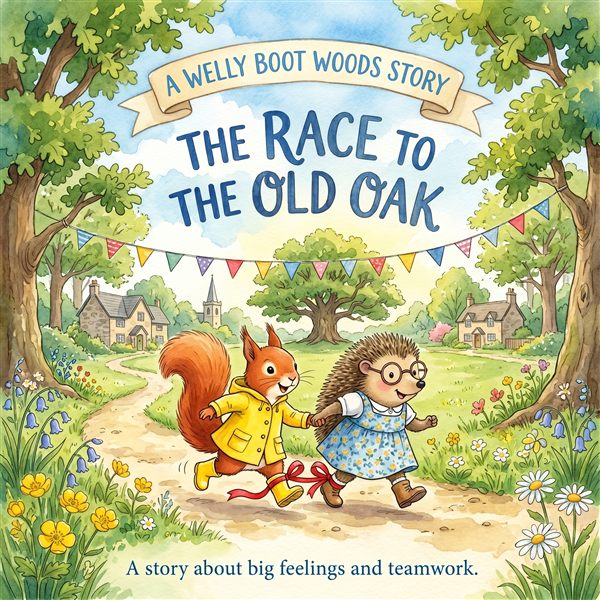
The Greatest of Races (Book 3)
It's the annual woodland race, and Pip Red Squirrel and Humphrey Hare both want to be champion! But when stubborn competition leads to tangled brambles and lost acorns, the friends learn that listening, sharing choices, and working as a team brings the greatest joy of all.
6. Frequently Asked Questions
The reflexive 'NO!' in toddlers is often an instinctual assertion of selfhood rather than a literal refusal. Developmental psychologists call this 'counterwill'—an automatic protective response to feeling commanded. When given a moment to process without pressure, or when offered the chance to choose how the activity starts, the resistance usually dissolves quickly.
Safety boundaries (such as holding hands in a car park or sitting in a car seat) cannot be optional. Calmly and physically hold the boundary with warmth: 'My number one job is keeping you safe. I cannot let you run in the road. You can hold my hand, or I can carry you to the gate.' Follow through without anger or lectures.
Toddlers learn best through external stories where characters face relatable dilemmas. In The Greatest of Races, Pip Red Squirrel and Humphrey Hare both want their own way, but learn that stubbornness leads to missing out on the joy of teamwork. Reading about characters making choices gives children a safe, non-threatening mirror to discuss feelings and collaboration.